

Testimonial video: script, interview questions and story structure
Updated 27 October 2026
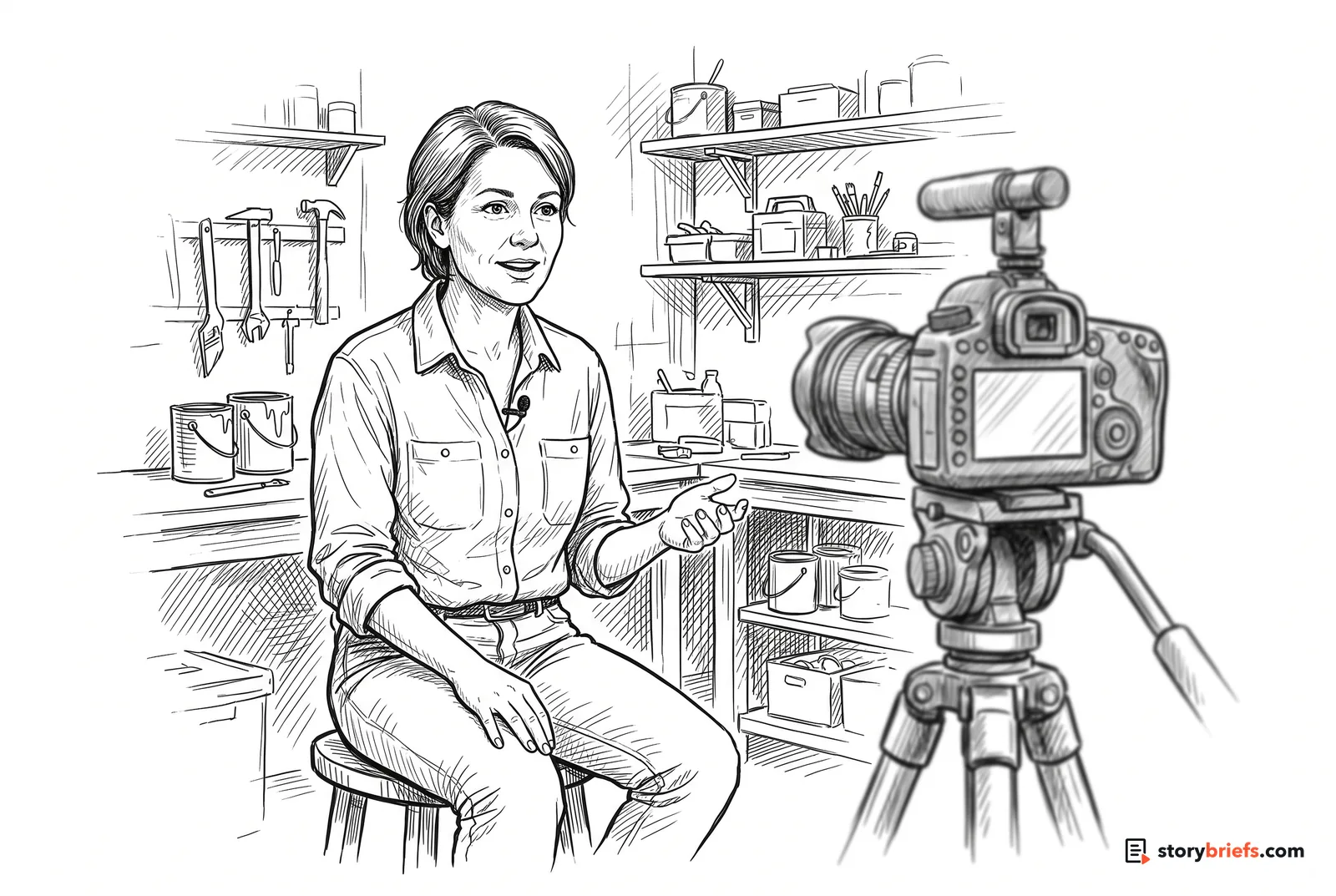
A good testimonial video is a short story about your customer, not an advert about you. Find one specific customer, ask about the moment before they found you, let them explain the change in their own words, and end on who they are now. Keep it to 60–120 seconds and cut every line that sounds like a brochure.
- Length
- 60–120 seconds (15–30 s cutdowns for social)
- Best for
- Building trust at the point someone is deciding
- Where to use it
- Sales pages, Proposals, Email follow-ups, Paid social
- Production level
- Interview + B-roll, one shoot day
What makes a testimonial video work
People don’t believe companies. They believe people like themselves. That’s the whole job of a testimonial video: to let a future customer meet a past one and think, “that’s me.”
Most testimonial videos miss because they’re built like adverts with a customer reading the lines. The fix is to build them like short documentaries. Find the customer’s real story, let them tell it, and edit for the moment of change.
The brief below gives you the structure, the questions that draw that story out, and what to film so the edit has something to work with.
The story structure
Every StoryBrief follows the five steps of the Storification framework. Here's how each one applies to this video.
Start with the customer's life before you
Open on the customer, not the company. Ask what was going on for them when the problem started. The more specific the detail (a time, a place, a number they remember), the more believable everything after it becomes.
“Every Friday afternoon I'd be in the office until eight, reconciling spreadsheets by hand.”
“We'd tried three agencies in two years. I'd honestly stopped expecting anything to change.”
Show what the customer believes
Your future customers don't just share a problem with this person, they share a belief. Draw it out: what did they refuse to compromise on? What mattered to them about how the problem got solved? This is where viewers decide 'that's someone like me'.
“I wasn't going to hand our clients over to someone who'd treat them like a number.”
“I care about doing things properly, even when it takes longer.”
End on identity, not a sales line
Skip 'I'd recommend them to anyone'. Instead, let the customer describe who they are now, or who this is right for. The viewer should feel invited to become that person, not pushed to buy.
“Now I'm the one leaving at five, and my team's the one telling me about wins.”
“If you're the kind of business that actually wants to know your numbers, you'll get it.”
Leave room for others to add their story
One testimonial is a claim; a series is a community. Plan the video as the first in a set, use the same question structure for every customer, and invite viewers to share their own experience in the comments or a reply.
“On screen: 'This is Sarah's story. What's yours?'”
Cut it for where it will travel
Shoot once, cut many times: a full 90-second story for the website, a 30-second version for ads, single-quote vertical clips for social, and a still with a pull quote for proposals. Add captions to everything, since most social video plays without sound.
“30 s cutdown: problem line → change line → identity line.”
Script template
| Beat | Time | Visual | Audio / VO |
|---|---|---|---|
| Cold open | 0:00–0:08 | Customer mid-sentence, tight shot, or B-roll of their workplace | Strongest 'before' line from the interview, no intro |
| Who they are | 0:08–0:20 | Wider shot, name and role lower third | Customer introduces themselves and what they do, in one or two sentences |
| The problem | 0:20–0:40 | B-roll of the old way of working | The specific moment it got too much; what they'd already tried |
| What they believed | 0:40–0:55 | Interview, slower pace | What mattered to them in choosing a solution |
| The change | 0:55–1:20 | B-roll of the new way of working; product or service in use | What's different now, with one concrete detail or result they're happy to share |
| Identity close | 1:20–1:35 | Customer smiling or in their element; end card | Who they are now, or who this is right for; logo and URL on the end card |
Interview questions
- Tell me about your business and what a normal week looks like for you.Why: Warms them up and gives you a clean introduction line.
- Think back to before you worked with us. What was going on?Why: Gets the Origin: the life before the change.
- Was there a particular moment when you thought 'something has to change'?Why: Specific moments make the most believable openings.
- What had you already tried? What happened?Why: Shows the viewer this person isn't easily impressed.
- When you were looking for help, what mattered most to you?Why: Draws out their Worldview, the belief viewers will identify with.
- What nearly stopped you from going ahead?Why: Addresses the viewer's own objections in someone else's voice.
- What's different now? Walk me through a day.Why: Gets the change as a scene, not a slogan.
- Is there a moment you realised it was working?Why: Often produces the most emotional line in the edit.
- Who do you think this would be right for?Why: Gives you the identity-based Invitation for the close.
- Is there anything I haven't asked that you'd want people to know?Why: Customers often say the best line when they think the interview is over.
Shot list
- Interview: main angle at eye level, customer looking just off camera at the interviewer
- Interview: second angle (tighter, from the side) for cutting between lines
- Wide establishing shot of the customer's workplace
- Customer doing their normal work (hands, screens, tools, customers)
- The 'before' if it can be recreated honestly, e.g. paperwork, old process
- Your product or service in use in their real setting
- Candid moments: talking to colleagues, laughing, walking in
- A still portrait for thumbnails and pull-quote graphics
What it costs
Ranges are USD for one finished testimonial plus cutdowns. Price rises with the number of locations, crew size and travel; it falls sharply if you film several customers on the same day, which most production companies will discount for. A phone, a clip-on mic and a window for light can produce a perfectly usable DIY version.
Common mistakes
- Scripting the customer. Viewers can hear memorised lines instantly. Ask questions and cut the answers together instead.
- Starting with your logo and company name. Start with the customer's problem.
- Choosing your happiest customer instead of your most typical one. Viewers need to see themselves.
- Generic praise ('great service, highly recommend'). Ask follow-up questions until you get a specific detail.
- Bad audio. People forgive average pictures, not echoey or noisy sound. Use a lapel mic and a quiet room.
- Making one long version and stopping there. Plan the cutdowns before the shoot.
Useful tools
- Descript: edit interviews by editing the transcript, and add captions
- Artlist: licensed music for the finished cut and social versions
FAQ
How long should a testimonial video be?
Aim for 60–120 seconds for the main version on your website, with 15–30 second cutdowns for social and ads. If the story is strong, viewers will watch two minutes; if it isn't, they won't watch thirty seconds.
Should I give customers a script?
No. Send them the topics in advance so they can think about their answers, then interview them. Ask them to answer in full sentences that include the question, so each answer makes sense on its own in the edit.
How many customers should I film?
Start with three if you can. One testimonial looks like a favour from a friend; three that follow the same structure look like a pattern.
Do I need permission to use a customer's testimonial?
Yes. Get a signed release that covers where and for how long you'll use the footage. Some industries, such as healthcare, law and financial services, have extra rules about testimonials, so check yours before publishing.
Can I use AI avatars instead of real customers?
Not for testimonials. A testimonial only works because a real person is vouching for you, and presenting a synthetic person as a customer misleads viewers and may breach advertising rules.
Testimonial videos by industry
- Patient testimonial video for dental clinics: brief, questions and scriptPlan a dental patient testimonial video that calms nervous patients: story structure, interview questions, script, consent tips and costs.
- SaaS customer testimonial video: brief, questions and scriptPlan a SaaS customer testimonial video that B2B buyers believe: who to interview, story structure, questions, script, approvals and real costs.